
Health economic modelling in nuclear medicine: setting innovation priorities or boundaries?
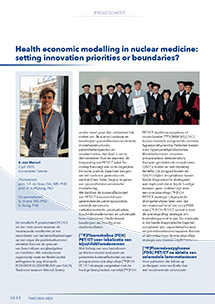
Dit proefschrift positioneert PET/CT als een instrument waarvan de meerwaarde voortkomt uit het veranderen van behandelbeslissingen op een wijze die patiëntuitkomsten verbetert binnen de grenzen van beschikbare zorgbudgetten en middelen.
Holmium-166 microsferen geïnjecteerd in pancreascarcinoom
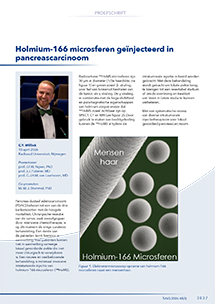
Pancreas ductaal adenocarcinoom (PDAC) behoort tot een van de drie kankersoorten met de hoogste mortaliteit.
Dutch nuclear medicine and radiology residency
The rapid advancements in medical imaging over the past few decades hold great promise for future diagnostic and treatment options, with hybrid imaging techniques such as PET/CT, PET/MRI, and theranostics among the most recent developments.
Unravelling the distribution of holmium microspheres following transarterial radioembolisation
Transarterial radioembolisation (TARE) is a locoregional therapy used in the treatment of both primary and secondary liver malignancies.
GLP-1 receptor imaging in type 2 diabetes and obesity
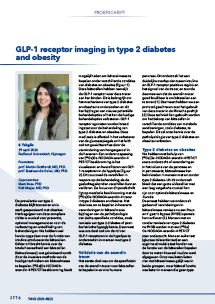
De prevalentie van type 2 diabetes blijft toenemen en is sterk geassocieerd met obesitas. Het begrijpen van deze complexe ziekte is cruciaal voor preventie, optimaal management en voor de verbetering en ontwikkeling van behandelingen.
Towards clinical implementation of quantitative PET and SPECT imaging
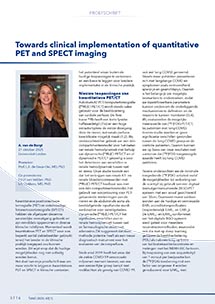
Kwantitatieve positronemissietomografie (PET) en enkelvoudige fotonemissietomografie (SPECT) hebben de afgelopen decennia aanzienlijke vooruitgang geboekt en zijn inmiddels opgenomen in diverse klinische richtlijnen.
Bridging targeted radionuclide and checkpoint inhibitor therapies: joining forces
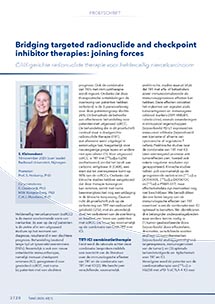
Heldercellig niercelcarcinoom (ccRCC) is de meest voorkomende vorm van nierkanker. Bij een op de vijf patiënten is de ziekte al in een uitgezaaid stadium op het moment van diagnose, resulterend in een slechtere prognose.
The clinical translation of targeted radionuclide therapy with Lu-177 and Ac-225: from radionuclide to standard of care
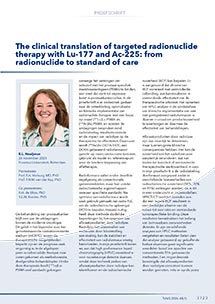
De behandeling van prostaatkanker blijft een van de uitdagingen binnen de moderne oncologie. Dit geldt in het bijzonder voor het gemetastaseerde castratieresistente stadium (mCRPC), waarin de therapeutische mogelijkheden beperkt zijn en de prognose vaak ongunstig is.
Microspheres in motion: investigating the parameters that influence radioembolization
Transarterial radioembolization (TARE) is a treatment method for liver tumours, during which radioactive microspheres are injected in the hepatic artery (HA) via a microcatheter.
[18F]MC225 and PET: in vivo measurements of the P-glycoprotein function at the human blood-brain barrier

P-glycoproteïne (P-gp), ook wel multidrug resistance protein 1 (MDR1 of ABCB1), is een transporter-eiwit op de bloed-hersenbarrière. De transporter is verantwoordelijk voor de klaring van verschillende neurotoxische stoffen uit het brein en lijkt hiermee een belangrijke rol te spelen bij de ontwikkeling van verschillende neurodegeneratieve aandoeningen