
Microspheres in motion: investigating the parameters that influence radioembolization
Transarterial radioembolization (TARE) is a treatment method for liver tumours, during which radioactive microspheres are injected in the hepatic artery (HA) via a microcatheter.
Column – 2026-01
Doel van een column is discussie veroorzaken. Het mag best wat wrijven, want zoals de gewaardeerde collega Otto Hoekstra zei: wrijving geeft glans.
Maxima Medisch Centrum
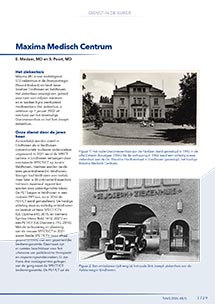
Máxima MC is een middelgroot STZ-ziekenhuis in de Brainportregio (Noord-Brabant) en heeft twee locaties: Eindhoven en Veldhoven.
T. Velleman – Dutch nuclear medicine and radiology residence: Exploring challenges and opportunities.

Medical imaging has undergone rapid developments over the past decades and has become an essential component of modern healthcare. Techniques in radiology, such as X-ray, ultrasonography, computed tomography (CT), and magnetic resonance imaging (MRI), together with nuclear medicine techniques including single-photon emission computed tomography (SPECT) and positron emission tomography (PET), enable early diagnosis, treatment monitoring, and image-guided therapies for a wide range of diseases.
A.C. Berrens – Tailoring prostate cancer surgery : radio- and fluorescence guidance to improve surgical accuracy

In dit proefschrift is onderzocht en bevestigd dat beeldgeleide chirurgie in prostaatkanker is een innovatieve manier is om met meer precisie te opereren. Er is eerst systematisch gekeken wat er tot op dat moment bekend was in de wereld en hierop verder gebouwd door een Delphi consensus te houden met een internationaal panel van experts.
Harry Mens informeert naar de laatste ontwikkelingen omtrent Lu-177-PSMA

Op uitnodiging van Harry Mens ( TV programma Business Class ) was Dirk Wyndaele als onafhankelijk nucleair geneeskundige vrijwillig actief bij UOMO ( Europese koepel van de diverse, nationale verenigingen van prostaatkanker patiënten ) uitgenodigd in Harry´s programma van 25 januari laatstleden.
F. Kleiburg – Clinical value of PSMA-targeted PET/CT imaging in prostate and non-prostate cancers

In the last decade, prostate-specific membrane antigen (PSMA) targeted PET/CT has emerged as a novel imaging modality that allows for more accurate detection of tumour lesions compared to conventional imaging (CT and bone scintigraphy). PSMA PET/CT can also provide a multitude of quantitative parameters that may reflect tumour burden and aggressiveness of the disease.
PSMA interview

PSMA forum – interview
PSMA ONDERWIJSMAAND
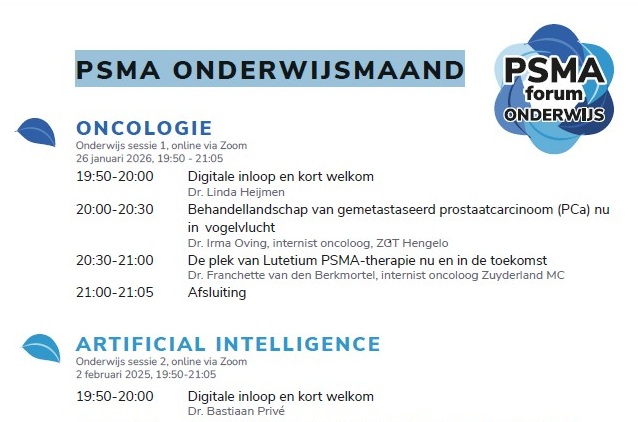
PSMA forum NL onderwijsmaand
Radioloog (vaste aanstelling) bij St Jansdal
St Jansdal, Harderwijk